
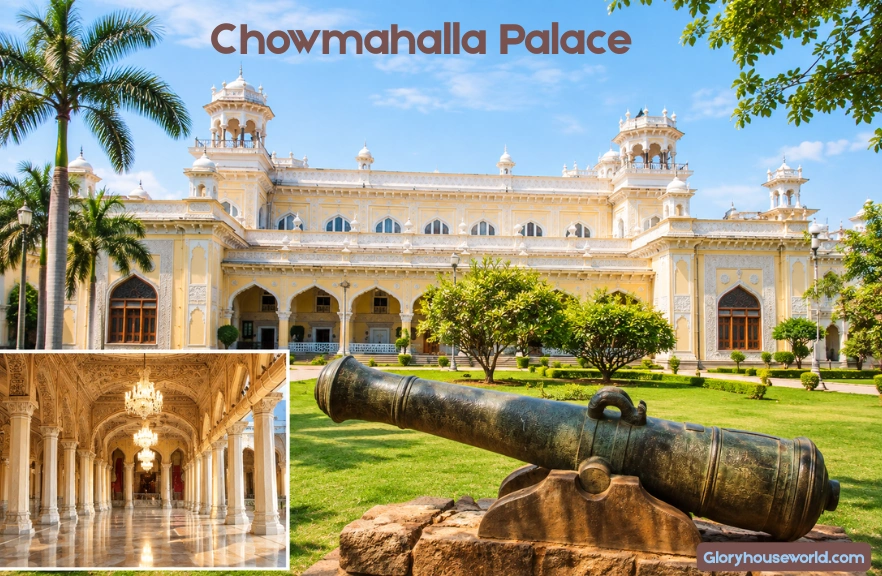
Chowmahalla Palace is a 12-acre royal complex in Old Hyderabad, built from 1751 onward by the Nizams of the Asaf Jahi dynasty. It features four neo-classical palaces, a grand throne hall, a stunning central courtyard, and a vintage car collection. Open Saturday to Thursday (10 AM to 5 PM), entry costs ₹150 for Indian adults, children under 10 ₹50, foreigners ₹500. It holds the UNESCO 2010 Award of Merit for cultural heritage conservation, making it one of the most celebrated restored palaces in Asia.
Quick Stats: Chowmahalla Palace
| Feature | Details |
|---|---|
| Full Name | Chowmahalla Palace (Chowmahallat) |
| Location | 20-4-236, Motigalli, Khilwat, Hyderabad, Telangana 500002 |
| Built | Construction began c. 1751 AD |
| Current Area | 12 acres (originally 45 acres) |
| Open Days | Saturday to Thursday |
| Chowmahalla Palace Timings | 10:00 AM to 5:00 PM (ticket counter closes at 5 PM) |
| Closed | Every Friday |
| Entry Fee (Indian Adults) | ₹150 |
| Entry Fee (Children below 10) | ₹50 |
| Entry Fee (Foreign Nationals) | ₹500 (passport required) |
| Photography (Mobile only) | ₹50 |
| Award | UNESCO Asia Pacific Merit Award, 2010 |
| Nearest Metro | MG Bus Station (Gowliguda), 3.7 km |
| Distance from Charminar | Less than 1 km |
| Annual Visitors | Approximately 3 to 4 lakh |
| Videography | Strictly prohibited |
Disclaimer: All details in this article are based on publicly available, verified information sourced from the official Chowmahalla Palace website, UNESCO documentation, and reputable travel and heritage publications. Entry fees, timings, and operational details are subject to change. Please verify current information at chowmahalla.in before your visit.
There are palaces, and then there is Chowmahalla Palace.
Step off the busy lanes of Old Hyderabad and through its arched gateway, and the city’s noise seems to fall away. What greets you instead is a world of gilded thrones, Belgian crystal chandeliers, century-old Rolls-Royces, and courtyards so elegantly proportioned they feel like they belong in another era entirely — because they do.
Located in the vibrant and bustling lanes of Motigalli, Hyderabad, Chowmahalla Palace is a sanctuary for the eyes and the soul. It was the seat of the Asaf Jahi dynasty, the official residence of the Nizams of Hyderabad, and the venue for coronations, public court, and grand state ceremonies that shaped the history of the Deccan plateau.
Today, this extraordinary complex draws history lovers, architecture enthusiasts, and curious travellers from across the world. According to Telangana Tourism data referenced in a January 2025 report, Chowmahalla Palace receives approximately 3 to 4 lakh visitors annually, a number that has been rising steadily since the revival of heritage tourism.
History and Ownership of Chowmahalla Palace
The Nizams and the Birth of a Dynasty
The princely state of Hyderabad was ruled by the Asaf Jahi dynasty, who trace their lineage to Central Asia. Their seat of power was shifted to Chowmahalla Palace in the mid-18th century. The dynasty was in power from 31 July 1724 to 17 September 1948.
Seven Nizams ruled from this complex across two centuries, each leaving their architectural and cultural imprint on the property.
Construction Timeline
Construction of Chowmahalla Palace started during the reign of Nawab Salabath Jung, the third son of Asaf Jah I, around 1751 AD.
Originally, the total area of the complex was 45 acres. Over time, it became a compact 12 acres, comprising the new Khilwat Mubarak, the four palaces — Afzal Mahal, Aftab Mahal, Mehtab Mahal and Tahniyat Mahal — a grand Clock Tower, a Buggy Khaana which stores the splendid vehicles used by the Nizams, and an assortment of other buildings and heritage structures.
The present-day Khilwat Mubarak was commissioned by HEH Mir Osman Ali Khan, the Seventh Nizam, at the end of August 1912, and inaugurated by him in January 1916.
A Property Timeline at a Glance
| Period | Key Development |
|---|---|
| 1751 | Construction begins under Nawab Salabath Jung |
| 1763 | Capital shifted from Aurangabad to Hyderabad by Asaf Jah II |
| 1857–1869 | Complex largely completed under Asaf Jah V |
| 1912–1916 | New Khilwat Mubarak commissioned and built by the Seventh Nizam |
| 1948 | Hyderabad merges into the Indian Union; royal rule ends |
| 2010 | UNESCO Asia Pacific Merit Award for cultural heritage conservation |
Who Owns Chowmahalla Palace Today?
The palace is still registered as the property of Barkat Ali Khan Mukarram Jah, who is considered the heir of the Nizams.
The restoration of the palace is widely attributed to the Princess of Chowmahalla Palace, Esra Birgen Jah, the former wife of HEH Mukarram Jah (the Eighth Nizam). She worked closely with conservation architects, craftsmen, and historians for years. She catalogued thousands of artifacts and tracked down furniture, royal documents, weapons, and ceremonial objects that had been scattered across the estate.
The prestigious UNESCO Asia Pacific Merit Award for cultural heritage conservation was presented to Chowmahalla Palace on March 15, 2010. UNESCO representative Takahiko Makino formally handed over the plaque and certificate to Princess Esra.
It is the state’s only palace to have been decorated with UNESCO’s 2010 Award of Merit, in addition to being awarded the prestigious INTACH Heritage Award twice.
Location and How to Reach Chowmahalla Palace
Address
20-4-236, Motigalli, Khilwat, Hyderabad, Telangana 500002
The palace sits in the heart of Old City, one of Hyderabad’s most historically rich and culturally vibrant neighbourhoods.
Charminar to Chowmahalla Palace Distance
The Palace is a veritable landmark in Hyderabad, and one of the prime points of convergence in Old City — the other being the marvellous Charminar, located less than 1 km away. If you are visiting Charminar, simply follow the road to the right of the monument and continue straight up to the Palace Gate.
Chowmahalla Palace Nearest Metro
The closest metro station is MG Bus Station (Gowliguda), 3.7 km from the palace. From there, auto-rickshaws or taxis are readily available.
By Bus, Train, and Private Transport
| Mode | Nearest Stop | Distance |
|---|---|---|
| Metro | MG Bus Station, Gowliguda | 3.7 km |
| MMTS Train | Yakutpura Railway Station | 2 km |
| City Bus | Charminar Bus Stand | Under 1 km |
| Car / Cab | Follow GPS; turn right at Charminar | Ample parking inside complex |
Buses stop directly opposite the main gate of the Palace. Ample parking is available inside the official palace compound, though it tends to fill up on weekends. Arriving early is recommended.
Exterior and Architectural Style
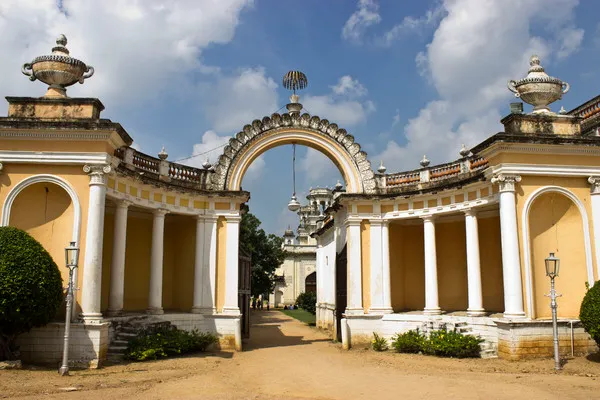
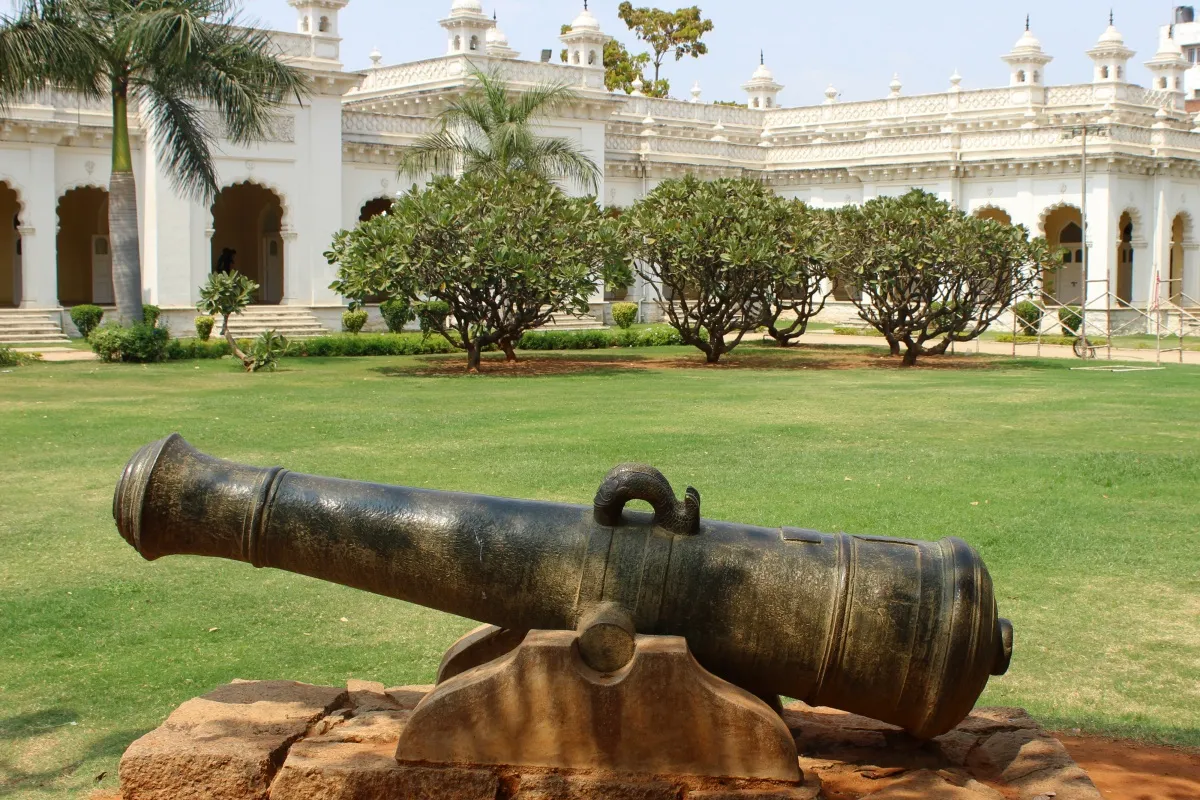
Chowmahalla Palace is not a single building. It is a layered city within a city, where Persian arches meet Mughal symmetry, European columns stand beside Indo-Saracenic turrets, and a 19th-century clock tower overlooks century-old cannon placements.
One of the most impressive things about the palace is its imposing architecture. The facade is made of an intricate network of beautiful domes, large windows, dramatic arches and delicately carved designs. The grounds feature lush green gardens, marvellous fountains, and numerous smaller palaces.
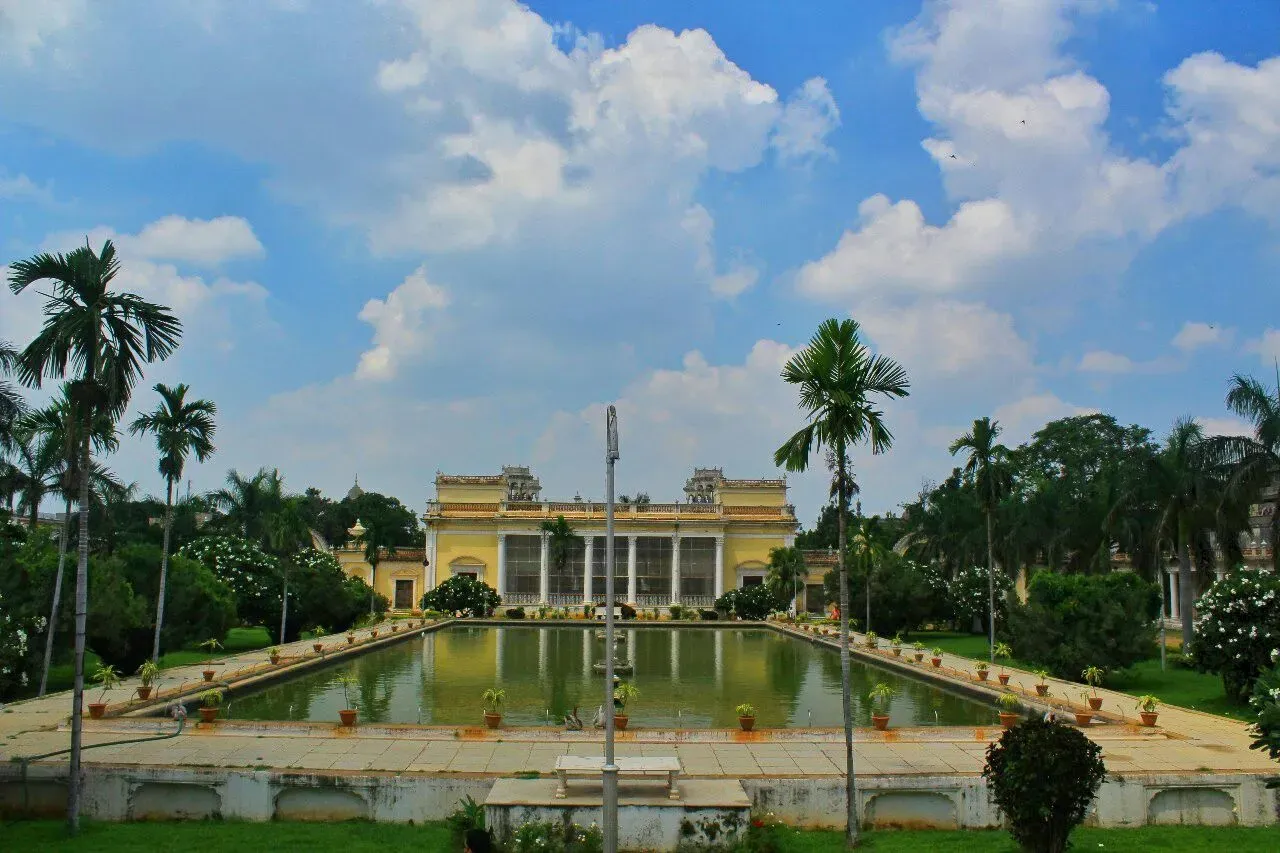
Four palaces, built in neo-classical style, are situated symmetrically opposite to each other around a gorgeous central pool. While the architecture of these four palaces has maintained a particularly elegant sense of uniformity, Aftab Mahal and Mehtab Mahal are held up by Ionic columns, while Afzal Mahal and Tahniyat Mahal are held up by Corinthian columns of double-height.
Architectural Influences
The palace draws from four major traditions, blended with remarkable sophistication:
- Persian: Ornate stucco work, arched domes, and the overall planning vocabulary of the Khilwat Mubarak
- Mughal: Symmetrical courtyards, central water features, and verandah design
- European / Neo-Classical: Ionic and Corinthian columns, European-style drawing rooms, Belgian chandeliers
- Indo-Saracenic: Arched galleries, turrets, and the supporting structures around the complex
Inside Chowmahalla Palace: The Interior Design and Layout
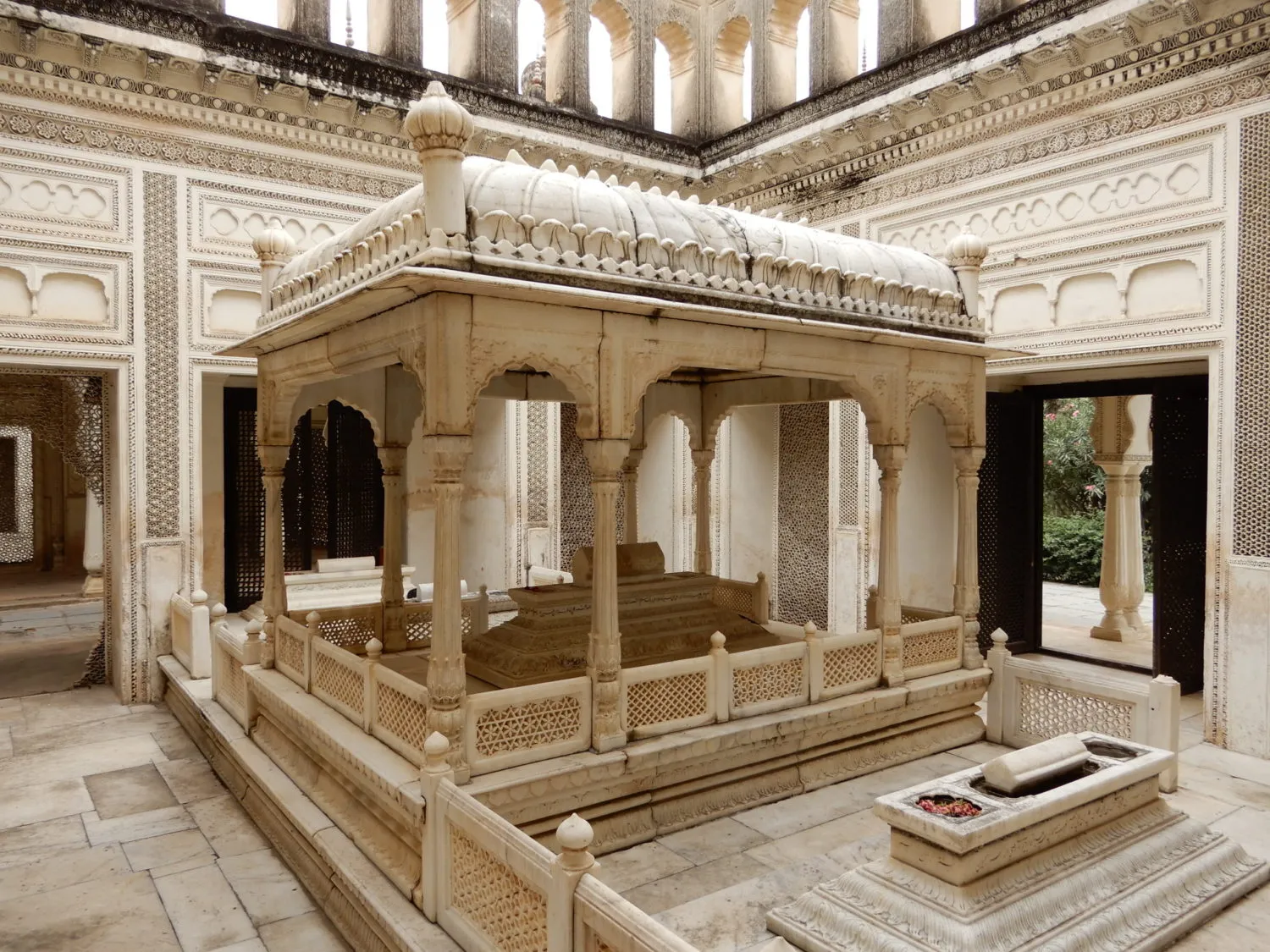
The Chowmahalla Palace Courtyard
The central feature of the complex is a large, beautifully maintained courtyard with a central cistern or water tank around which the four palaces stand symmetrically.
The Chowmahalla (four palaces) stand symmetrically opposite to each other around a large cistern of water, forming a protective enclave of grandeur and historic connection.
The Chowmahalla Palace courtyard is particularly striking in the cooler morning hours, when the light falls across the marble-finished surfaces of the buildings and the still water reflects the colonnaded facades. This open space is what gives the complex its sense of breathable grandeur, rather than the enclosed, claustrophobic feel of some older fortresses.
Khilwat Mubarak: The Throne Room
The undisputed centrepiece of Chowmahalla Palace is the Khilwat Mubarak.
The structure is a result of creative cross-pollination — a graceful blend of Mughal, Qutb Shahi, Iranian and Turkish influences, architectural genius and dedicated labour. While the main double-height darbar hall was created in the Turko-Iranian style, the columns of the verandas are reminiscent of the Qutb Shahi age. In the center of the grand durbar hall sits a marble throne (Takht-i-Nishan), covered in a Mughal-style masnad (seat cover). The hall was used for coronations, grand ceremonies and for holding public court with citizens and public officials.
The most impressive and magnificent structure in the palace complex is a large hall with a high ceiling adorned with 19 crystal chandeliers that sparkle like stars.
Today, Khilwat Mubarak functions as a multi-gallery exhibition space:
- Silsila-a-Asafia — chronicles the lives and achievements of the Nizams of the Asaf Jahi dynasty
- Mahallat — rare photographs of the women of the royal zenanas, documenting their lives and fashion
- Seileh Khana — a breathtaking weapons display featuring swords, shields, guns, bows and arrows
- Upper floors house galleries of paintings, crockery, cutlery, and handlooms
The Chau Mahal Complex: Four Palaces, Four Stories
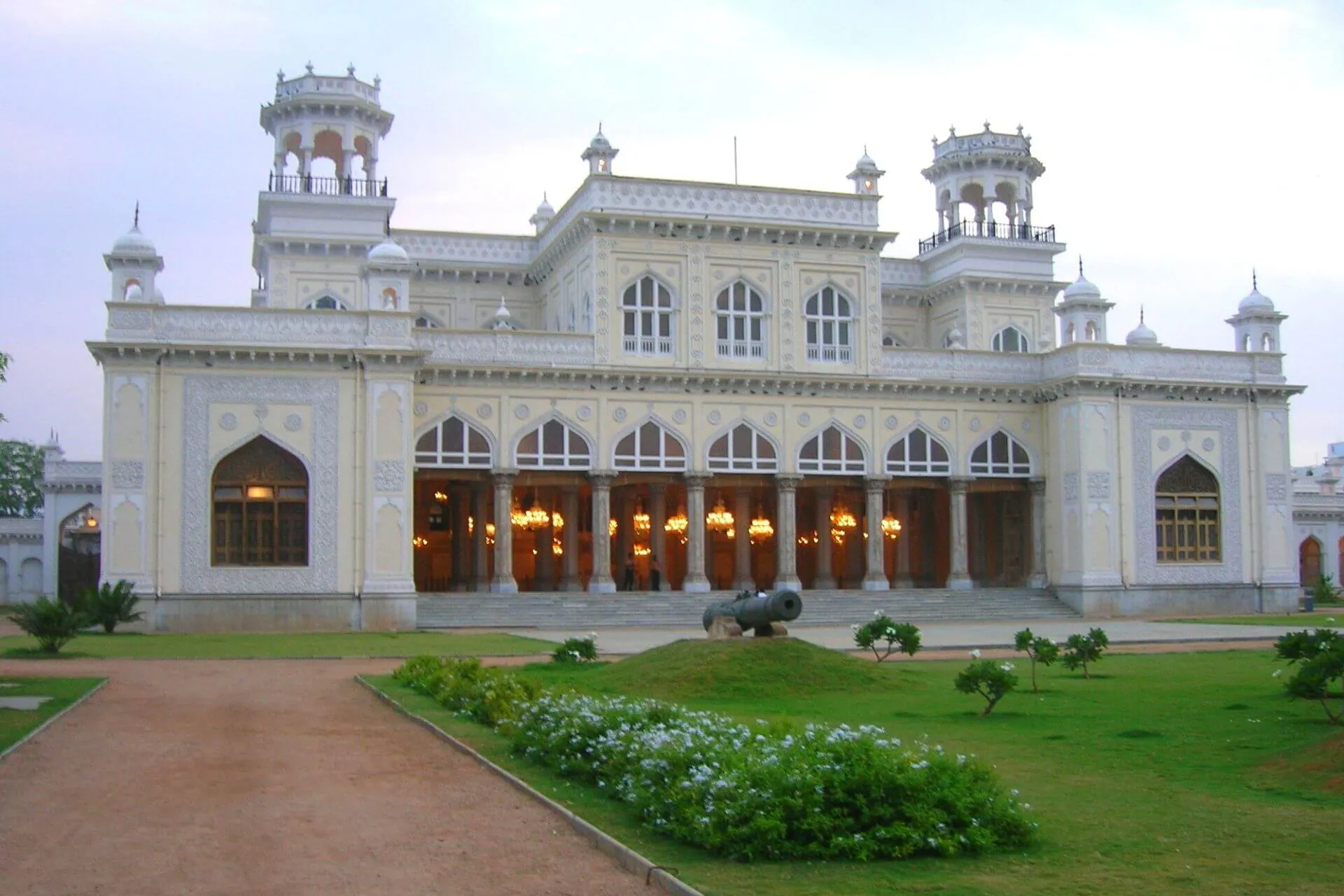
Afzal Mahal: The Royal Drawing Room
The Royal Drawing Room has found its home at Afzal Mahal. Since the time of the Fifth Nizam, the structure was used as the drawing room to receive foreign dignitaries and guests. The ground floor was furnished in the European style and remains intact till date. There are numerous objects of precious art adorning the walls on every corner of Afzal Mahal, including Belgian chandeliers and glass cabinets with immaculately preserved knick-knacks. A flawlessly preserved dining room sits behind railings on the ground floor, as does a billiard room with a table.
Aftab Mahal: The Women’s Court
For a glimpse into the lifestyles of the women of the court, step into Aftab Mahal. Different ceremonies and social contexts — weddings, farewells, tea parties, gift exchanges — are beautifully depicted using mannequins dressed in the finest possible specimens of textiles and embroideries. The exhibition is titled Tamanna: Reflections of the Royal Zenana.
Mehtab Mahal: The Library
The library, housed at Mehtab Mahal, is diligently taken care of by a hard-working team of librarians and archivists. The library hosts a large collection of history, philosophy, political science, fiction and non-fiction books. The archives have been lovingly restored by the team over years of diligent work.
Tahniyat Mahal: Mughal Opulence on Display
Tahniyat Mahal captures the essence and grandness of the Mughal era with exhibitions of sparkling chandeliers, Mughal and European furniture, textiles, artisanal objects and grand cutlery. The diwan-khana in the main hall houses a luxurious throne with the masnad and a ceremonial sword. The insignia standard of Mahi-o-Maratib — a Mongol emblem of royalty introduced in India by Timur — rests in the background. The emblem is a symbol of the highest dignity bestowed on the Nizam by the Mughals.
Standout Features and Amenities
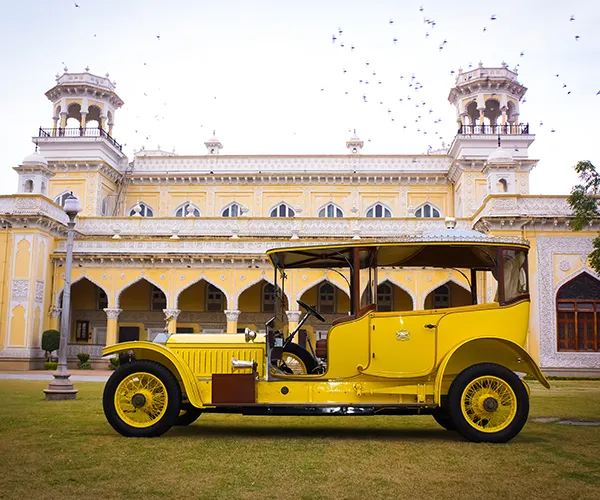
The Vintage Car Collection (Buggy Khaana)
No visit to Chowmahalla Palace Hyderabad is complete without seeing the Buggy Khaana.
The Buggy Khaana houses the collection of the Nizams’ vintage cars and is open to the public. The vintage car collection includes a 1912 Rolls Royce Silver Ghost and a 1937 Buick convertible. These cars offer a glimpse into the Nizams’ opulent lifestyle. The private collection, accessible to visitors who tour the palace complex, includes vintage Rolls-Royces, Bentleys, and a range of well-maintained American cars.
Other Supporting Buildings
The structures within the complex include Roshan Bangla, Saman Bangla, Council Hall, Bara Imam, and Shishe Alat.
- Roshan Bangla — situated to the left of Khilwat; named after the Sixth Nizam’s mother, Roshan Begum
- Council Hall — where the Nizam met important officials and dignitaries; now a museum with manuscripts and books
- Bara Imam — the administrative wing, with Indo-Saracenic arches
- Shishe Alat — the guest rooms, architecturally mirroring the Bara Imam
Canteen, Souvenir Shop, and Facilities
Visitors are invited to avail of snacks and drinks at the canteen, located near the entrance gate. A beautifully curated souvenir shop is packed with a wide range of decorative items, showpieces, jewellery, and artwork.
The palace management recommends wearing comfortable walking shoes, as the terrain alternates between marble, grass, and gravel. Consumption of alcohol, cigarettes, and tobacco is strictly prohibited.
Chowmahalla Palace Tickets and Entry Fee
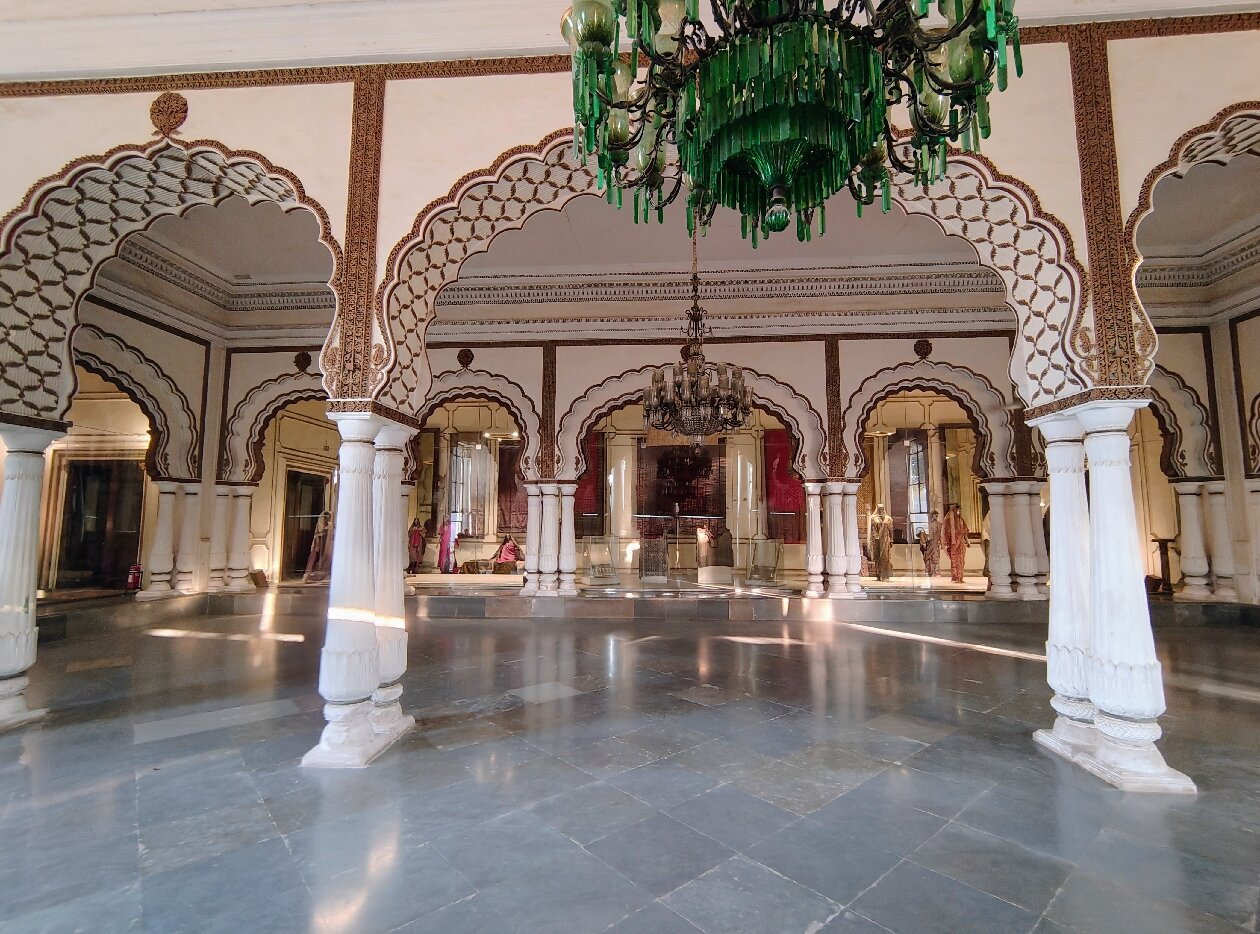
Chowmahalla Palace tickets are priced as follows: Indian Citizens (Adults) — ₹150, Children below 10 years — ₹50, Foreign Nationals (based on passport) — ₹500, Photography charges (Mobile only) — ₹50.
- Tickets are purchased at the on-site ticket counter
- The ticket counter closes at 5 PM
- All visitors must vacate the palace premises by 5:30 PM
- Shooting, filming, and professional videography are strictly prohibited
The palace is also available for corporate and private bookings through the official website for events, shoots (with prior permission), and cultural evenings.
Chowmahalla Palace Timings at a Glance
| Day | Opening Hours |
|---|---|
| Saturday | 10:00 AM to 5:00 PM |
| Sunday | 10:00 AM to 5:00 PM |
| Monday | 10:00 AM to 5:00 PM |
| Tuesday | 10:00 AM to 5:00 PM |
| Wednesday | 10:00 AM to 5:00 PM |
| Thursday | 10:00 AM to 5:00 PM |
| Friday | CLOSED |
Best time to visit: Early morning on a weekday to avoid crowds and enjoy cooler temperatures. Summer months (May and June) can be particularly hot, so early arrival is especially recommended.
Chowmahalla Palace Reviews: What Visitors Say
Chowmahalla Palace consistently earns strong praise from visitors for its architecture, atmosphere, and the sheer breadth of its collections. These are representative sentiments drawn from publicly available traveller feedback:
“This place is like a forgotten dream. It is a testimony to the fact that what opulent and luxurious lives our Nawabs used to have. From the furniture to textiles to Rolls Royce cars, this palace really mesmerized us. Good place for photography. Located within walking distance from Charminar.”
“The palace is truly beautiful and offers a glimpse into the royal heritage of Hyderabad. The architecture, vintage collections, and overall ambiance are impressive.”
“It is the most spacious palace adorned with huge crystal chandeliers. There is a museum displaying antiques, crockery, weapons of their era. The place is well-preserved and nicely maintained. You can also dress up in jewels and buy souvenirs from their in-house shop.”
“Chowmahalla Palace was a terrific place to explore and will interest you if you like antiques, architecture, or are looking for a peaceful place to walk around.”
Common visitor tips from Chowmahalla Palace reviews:
- Allow at least 2 hours to do the complex justice
- Visit the Buggy Khaana before the crowds arrive
- The Khilwat Mubarak hall with its crystal chandeliers is the undisputed highlight
- Carry your own water bottle
- The souvenir shop near the entrance is worth a browse
? Frequently Asked Questions
Q1. What are the Chowmahalla Palace timings?
Open Saturday to Thursday, 10:00 AM to 5:00 PM. Closed every Friday.
Q2. What is the Chowmahalla Palace entry fee?
₹150 for Indian adults, ₹50 for children below 10, ₹500 for foreign nationals, and ₹50 for mobile photography.
Q3. What is the Chowmahalla Palace nearest metro station?
MG Bus Station (Gowliguda) on the metro network, approximately 3.7 km from the palace.
Q4. What is the distance from Charminar to Chowmahalla Palace?
Less than 1 km. Turn right at Charminar and follow the road directly to the Palace Gate.
Q5. Who is the Princess of Chowmahalla Palace?
Princess Esra Birgen Jah, former wife of HEH Mukarram Jah (the Eighth Nizam), spearheaded the restoration of the palace. The UNESCO Award of Merit in 2010 was formally presented to her.
Q6. Can I book Chowmahalla Palace for a private event?
Yes. The palace accepts corporate and private bookings through its official website at chowmahalla.in.
🏠 Explore More Iconic Houses And Properties: –
- Mannat Shahrukh Khan House
- Tanya Mittal House In Gwalior
- Shetty Tower
- Nawazuddin Siddiqui House
- Dharmendra Farm House
- Neeraj Chopra House
- Rinku Singh House
- Triggered Insaan House Location
- Radhakishan Damani House
- Vijay Mallya House Bangalore
- Ratan Villas Sariska
- Sushant Singh Rajput House
- Shalini Passi House
- Gautam Adani House
- Kumar Mangalam Birla House
- Harshad Mehta House
- Salman Khan Farm House
- Gautam Singhania House
- YS Jagan Mohan Reddy House
